block the path
Block the Path time controls and Elo ratings explained
Understand Block the Path’s Bullet, Blitz, Rapid and Classic clocks, increments, timeouts and Elo changes. Choose a time control for your first online match.
Block the Path offers Bullet 1+0, Blitz 3+2, Rapid 5+5 and Classic 10+0 online games. The first number is each player’s starting minutes; the second is seconds added after a move. Elo changes in rated matches, while bot practice and private unrated games do not affect it.
What does 5+5 mean?
| Mode | Starting time per player | Increment |
|---|---|---|
| Bullet · 1+0 | 1 minute | None |
| Blitz · 3+2 | 3 minutes | 2 seconds |
| Rapid · 5+5 | 5 minutes | 5 seconds |
| Classic · 10+0 | 10 minutes | None |
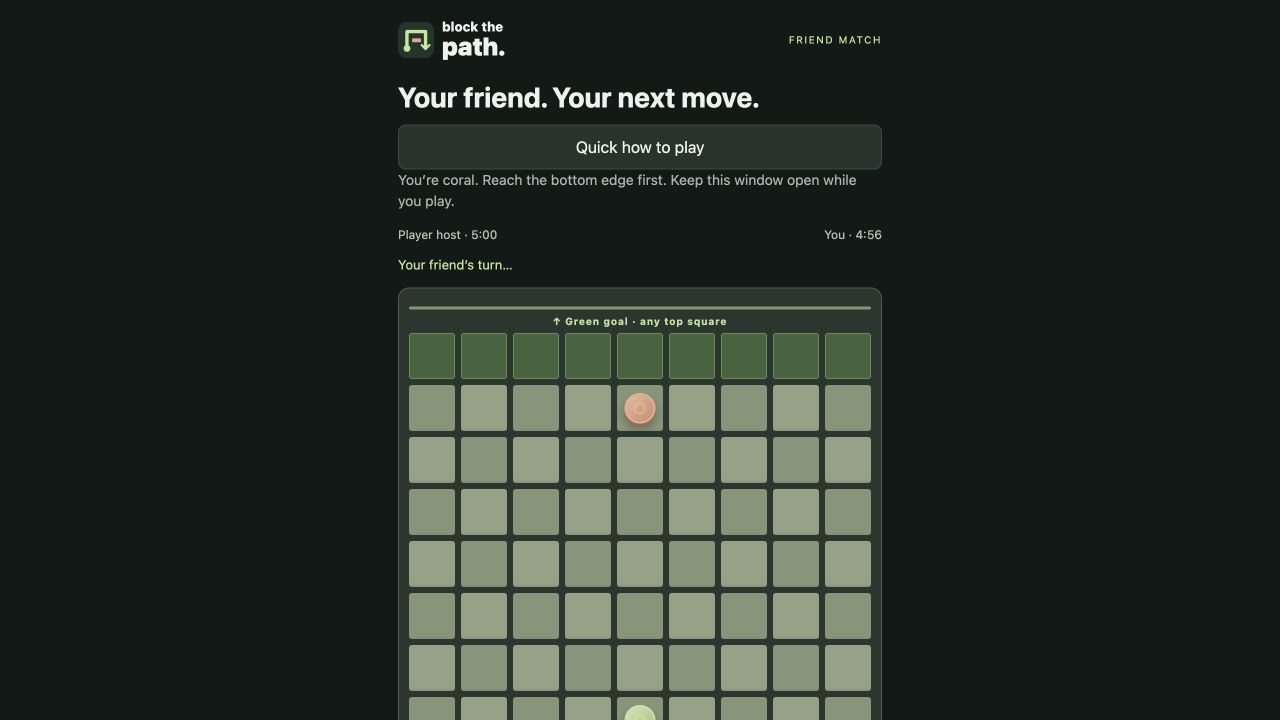
An increment is added after a valid non-winning action, whether you moved a pawn or placed a wall. It gives you more thinking time as the game continues. A 5+5 game therefore does not have a fixed total duration of ten minutes.
Choose a clock for learning
Classic gives you ten minutes at the start and is a useful option when you want to trace routes carefully. Rapid gives less starting time but adds five seconds after each completed action. Try either while learning wall placement.
Bullet leaves little room to count long detours. Try it after movement and wall controls feel familiar. The best learning clock is one that lets you explain your decisions without repeatedly losing on time.
What happens when time runs out?
Only the active player’s clock decreases. The server checks the remaining time and decides a timeout; a move that arrives after the clock expires cannot rescue the game. Closing a tab or losing your connection does not pause the clock.
If you need to stop an active game, use the resignation control. For a private invitation, both players should be ready before the guest joins, because that starts the match.
How Block the Path Elo changes
New profiles start at 1200. The current rating calculation uses an Elo update with a K-factor of 32. Beating a stronger player earns more points than beating a weaker one; the reverse applies to losses.
For example, if two players are both rated 1200, a decisive rated game gives the winner 16 points and removes 16 from the loser. That example describes Block the Path’s current implementation, not a rating shared with another game or service.
Ratings are a matchmaking signal, not a judgement of your potential. Early results can move your rating while you are still learning. Private unrated invitations and bot practice let you experiment without changing it.
Prepare for your next online game
Learn the movement and wall rules first, then play a few bot practice games. When you are ready, sign in to the club for rated matchmaking, or share a private invitation for a casual game.